Human Archive: Building Data Infrastructure for Physical AI

The recent progress of large language models has been driven by the availability of massive datasets sourced from the internet. Robotics and physical AI face a different challenge: there is no equivalent dataset that captures how humans interact with the physical world. Human Archive is building infrastructure to address that gap.
The company collects and structures multimodal real-world data that can be used to train robotics systems, embodied AI models, and other forms of physical intelligence. Through a network of data collection operations, workers use custom hardware equipped with cameras and sensors that capture how people perform everyday physical tasks in homes, restaurants, hotels, industrial settings, and other real-world environments.
The datasets go beyond standard video recordings. Human Archive combines egocentric video, depth sensing, motion capture, tactile information, and other sensor data into synchronized datasets designed for robotics and AI research. According to the company, it has deployed more than 1,000 active headsets and operates over 50 different data collection devices across multiple locations.
The company participated in the Winter 2026 batch of Y Combinator and recently raised $8.2 million in seed funding. The round was led by Wing Venture Capital and NVP Capital, with participation from Y Combinator and angel investors associated with organizations including OpenAI, Nvidia, Google, Meta, Mercor, AfterQuery, BAIR, and SAIL.
Founding Team
Human Archive was founded by Raj Patel, Rushil Agarwal, Samay Maini, and Shloke Patel. The team met long before starting the company and brings together backgrounds spanning robotics, hardware, machine learning, and operations.

Rushil Agarwal is a co-founder of Human Archive and one of the company’s early architects. Before founding the company, he studied in the Management, Entrepreneurship & Technology (MET) program at UC Berkeley, combining engineering and business education. At Human Archive, he focuses on building the systems and operational infrastructure required to collect and organize large-scale multimodal datasets for robotics applications.
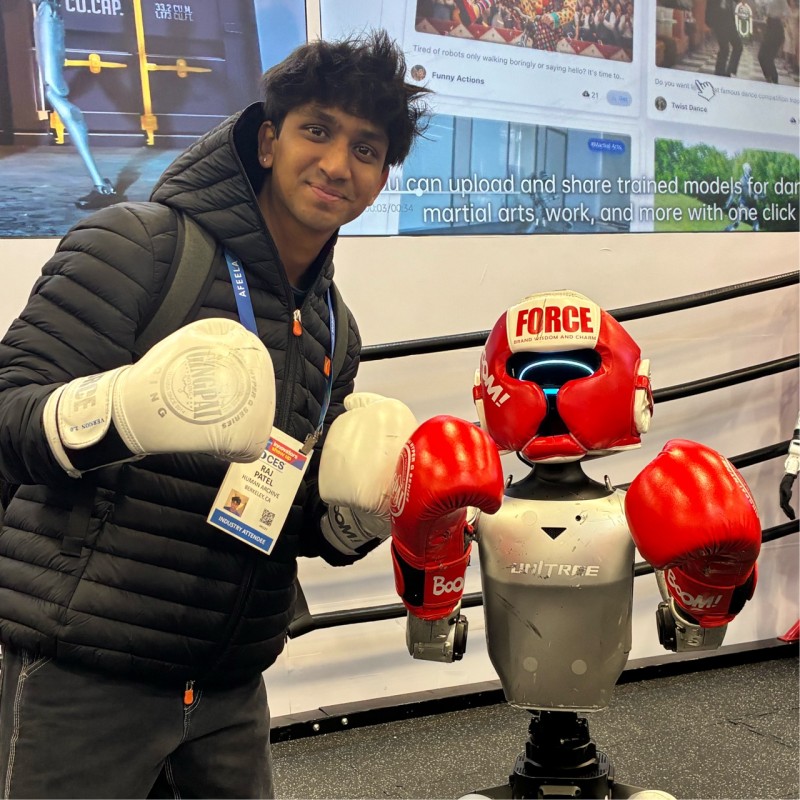
Raj Patel serves as CEO of Human Archive. He previously attended UC Berkeley and has led the company’s strategy, partnerships, and expansion efforts. Under his leadership, Human Archive has developed a large-scale data collection network focused on generating datasets for robotics and embodied AI systems.

Samay Maini is a co-founder of Human Archive and has a background in software engineering and machine learning. His work focuses on the technical systems that support Human Archive’s data platform and the processing of multimodal datasets used by robotics and AI researchers.

Shloke Patel studied engineering and robotics-related disciplines at Stanford University before co-founding Human Archive. He contributes expertise in hardware systems and sensing technologies, which form a key part of the company’s approach to collecting real-world training data.
As investment and research activity in robotics continues to accelerate, access to high-quality real-world data is becoming an increasingly important part of the AI stack. Human Archive is one of a growing number of companies focused on building the infrastructure required to train the next generation of physical AI systems.