PerfectBit: Building the Verified Data Layer for Physical AI
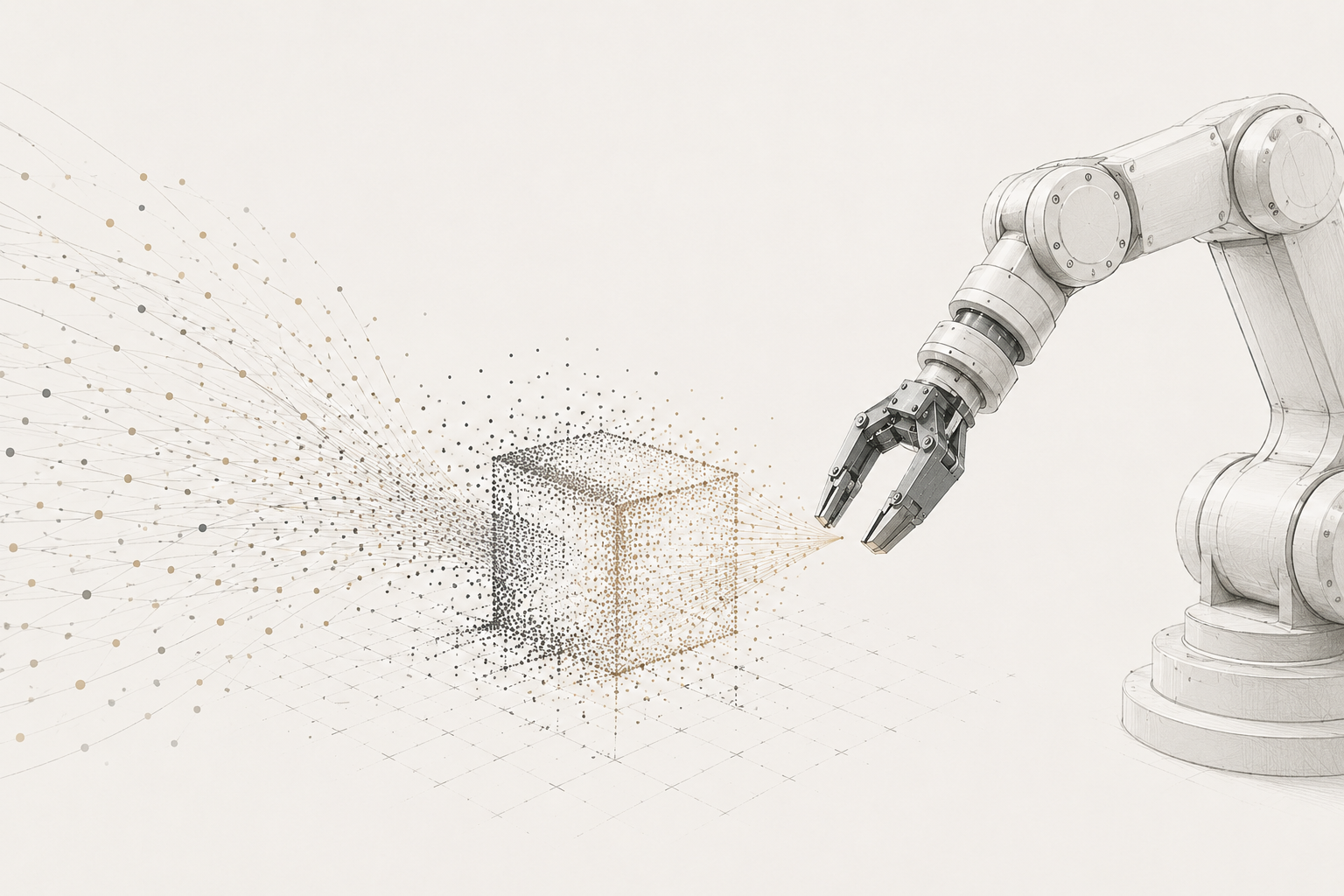
For years, the conversation around artificial intelligence revolved around larger models and more compute. Today, a different constraint is becoming increasingly visible: data.
As frontier AI models continue to improve, simply collecting more internet data is no longer enough. Large portions of the web are noisy, repetitive and difficult to verify, while many of the capabilities required for physical AI cannot be learned reliably from publicly available content alone. As our evaluation showed, progress at the frontier is increasingly constrained by the quality of training data rather than compute or model architecture.
One area where this challenge is particularly evident is physical AI—models that need to understand motion, reason about the physical world and predict how objects interact. Unlike mathematics or software, where outputs can often be verified automatically, there has been been no scalable way to generate large amounts of verifiable multimodal training data for physical reasoning.
This is the problem PerfectBit is solving.
Building verified data instead of collecting it
PerfectBit, a San Francisco startup that recently graduated from Y Combinator’s Spring 2026 batch, develops verified multimodal datasets and reinforcement learning environments for frontier AI models. Rather than relying on traditional human annotation, the company generates synthetic environments in which every training example can be validated against a known ground truth.
The company’s approach is what the founders describe as “correct by construction.” Instead of asking humans to determine whether an answer is correct, PerfectBit creates simulation environments where correctness is built directly into the data generation process. The output includes aligned multimodal signals—including RGB video, depth maps and segmentation data—that are exact in simulation but difficult to obtain consistently from real-world data.
Rather than building another foundation model, PerfectBit focuses on a different layer of the AI stack.
Its product is training data.
The company’s datasets and reinforcement learning environments are designed to work independently of a particular model architecture. As new AI architectures emerge, the need for reliable, verifiable training data remains. By focusing on this layer of the stack, PerfectBit is developing infrastructure that can support a wide range of AI systems rather than a single model.
Built by people who have worked at the frontier
PerfectBit was founded by Peter Vajda and Seiji Yamamoto, who together bring nearly two decades of experience building AI systems at Meta.
Peter previously served as Director of Media Generation, leading work on projects including Emu, Movie Gen and MoCha. Earlier in his career, he worked on efficient deep learning for AR/VR vision systems and is also a Visiting Assistant Professor at Stanford.
Seiji spent nine years at Meta as a Senior Staff Research Scientist, contributing to the Core Llama organisation across large language models, computer vision and speech. Before joining Meta, he held engineering roles at Palantir and Salesforce. He holds a PhD in Physics and has published research in PNAS and Physical Review Letters.
“As AI systems become more capable, the quality of the data they learn from becomes increasingly important. PerfectBit is approaching this challenge from first principles, with founders who have spent years building frontier AI systems themselves. We believe that combination gives the company a strong foundation to build an important piece of AI infrastructure.”
Jan Kasper, Managing Partner at ZAKA VC
Why we invested
PerfectBit combines several characteristics we rarely see together at such an early stage: a technically ambitious problem, a differentiated approach rooted in simulation and verification, founders with deep experience building frontier AI systems, and early validation from both customers and the broader AI community.
The funding round was oversubscribed and included Y Combinator, alongside angel investors from OpenAI, Anthropic, DeepMind and Meta.
Building more capable AI systems is no longer only about scaling compute or improving model architectures. Increasingly, it also depends on the quality of the data those systems learn from. PerfectBit is building exactly that layer.